THE NUMBER
Cubing a number
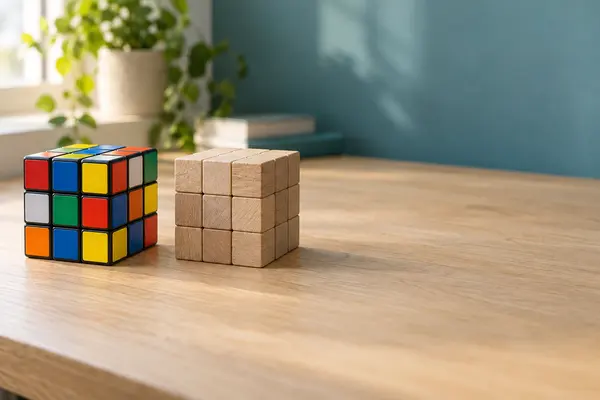
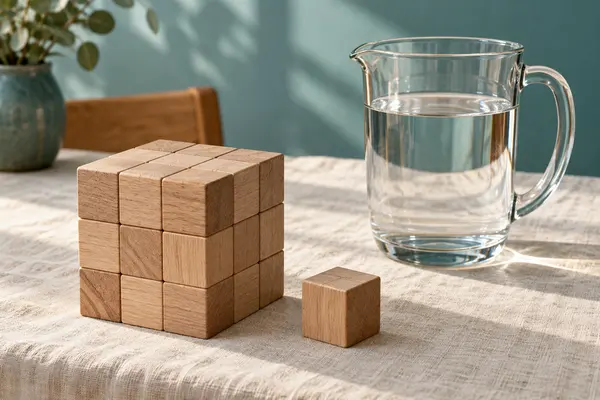
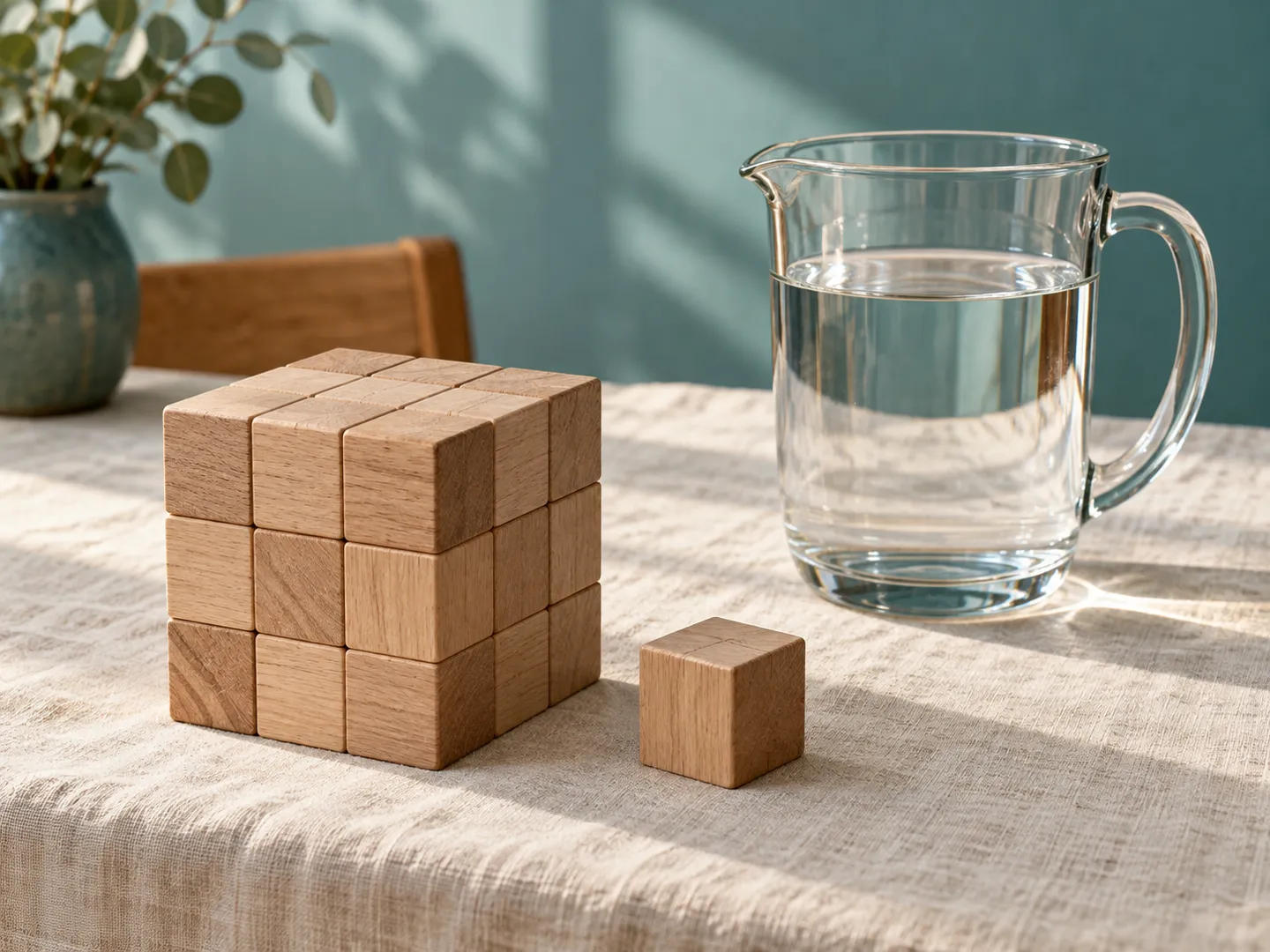
Multiply a number by itself three times: 3³ = 3 × 3 × 3 = 27, the blocks in a three-by-three-by-three stack.
Try the cube builder doodlecubed
00NUMBERS IN THREE DIMENSIONS
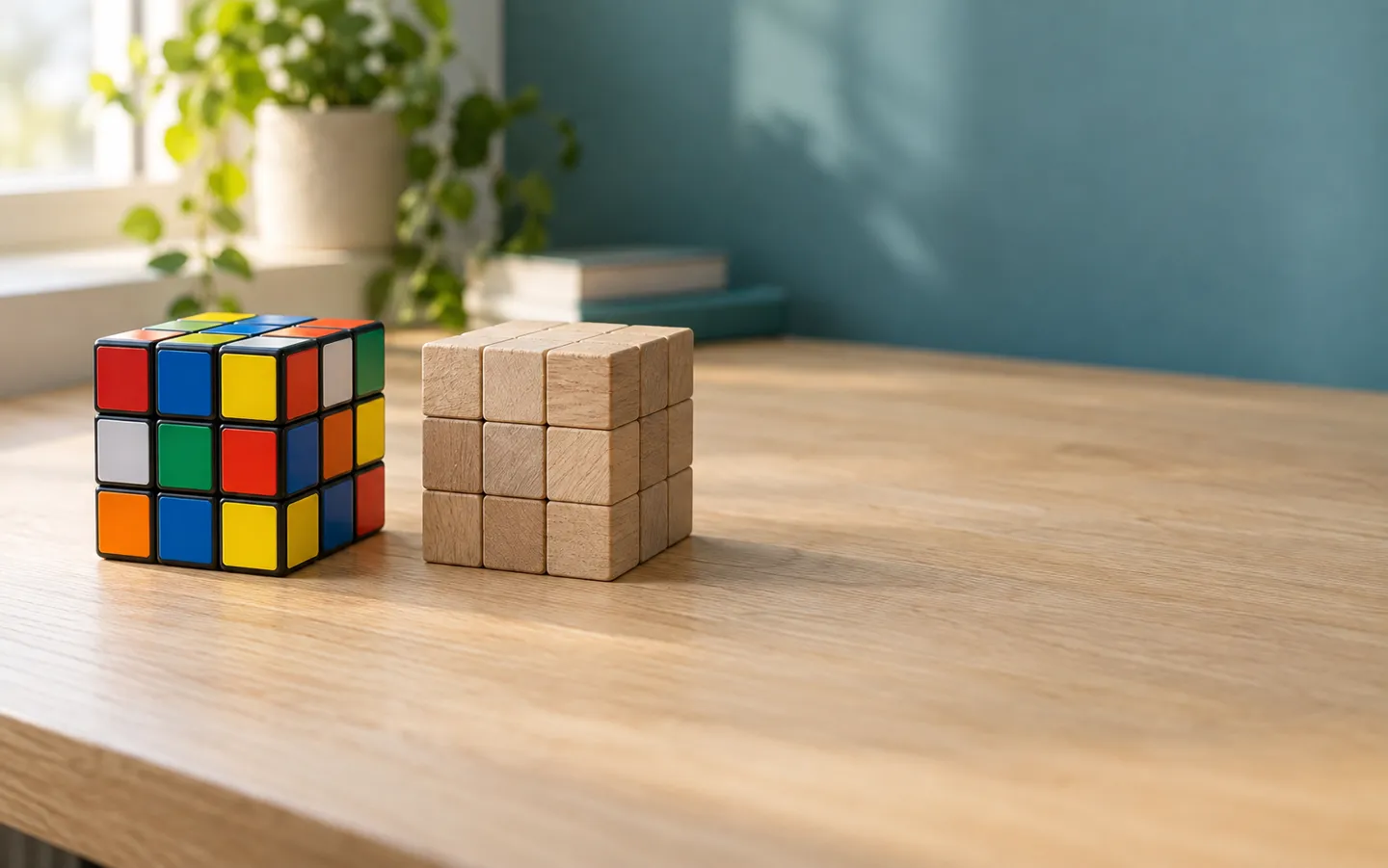
From a single block to 43 quintillion puzzle positions.
Cubing a number means multiplying it by itself three times. It is how we measure volume, why a litre is a box 10 cm on each side, and the reason a palm-sized puzzle cube can be scrambled into about 43 quintillion different positions. Here is the maths, in plain English.
Plain English, with the sources linked.
Build a cube01Principles
02THE SHORT ANSWER
Cubes grow fast. That is true of blocks,
of boxes and of puzzle positions.
THE NUMBER
Multiply a number by itself three times: 3³ = 3 × 3 × 3 = 27, the blocks in a three-by-three-by-three stack.
Try the cube builderTHE PUZZLE
The 3×3×3 puzzle cube can reach 43,252,003,274,489,856,000 different positions by turning its faces.
Where that comes fromTHE PROOF
In 2010 a team showed that every position can be solved in 20 moves or fewer, and some need all 20.
How it was proved03A QUICK CUBE BUILDER
Pick the length of one side, in blocks. The builder shows how many identical blocks you need to make a solid cube that size.
The bar compares each cube with the 1,000 blocks of a 10-sided cube. Notice how small the first few are: cubes grow very quickly.
04TWO RESULTS WORTH KNOWING
One took decades of computer time.
The other began with a taxi’s number.
20 moves
Moves needed for the hardest position
Tomas Rokicki, Herbert Kociemba, Morley Davidson and John Dethridge split the 43 quintillion positions into 55,882,296 groups and solved them all, using about 35 CPU-years of idle computer time donated by Google. The proof was published in 2013.
THE PUZZLE CUBE · 2010
1³+12³ = 9³+10³
Two cubes, two different ways
1729 is the smallest number that is the sum of two positive cubes in two different ways. It is called the Hardy-Ramanujan number, after a famous conversation between the two mathematicians about a taxi’s number.
CUBE NUMBERS · 1729
Both are about cubes, but in different senses: one counts the arrangements of a physical cube, the other is pure arithmetic with cube numbers.
05TRY IT YOURSELF
To cube in your head, square first and multiply by the number again: 4² = 16, and 16 × 4 = 64.
Double every edge of a box and its volume grows eight times, because 2³ = 8. Triple the edges and it grows 27 times.
A box 20 cm by 10 cm by 10 cm holds 2,000 cm³. Divide by 1,000 and you have its volume in litres: 2 litres.
The cubes of 0 to 9 all end in different digits. 8³ = 512 ends in 2 and 2³ = 8 ends in 8, so a cube’s last digit points back to its root’s.
06CUBE FACTS
The cube numbers start 1, 8, 27, 64, 125, 216, 343, 512, 729 and 1,000. Each one is a whole number multiplied by itself three times.
The litre is a special name for the cubic decimetre: a cube 0.1 m (10 cm) on each side. A thousand of them fill one cubic metre, because 10³ = 1,000.
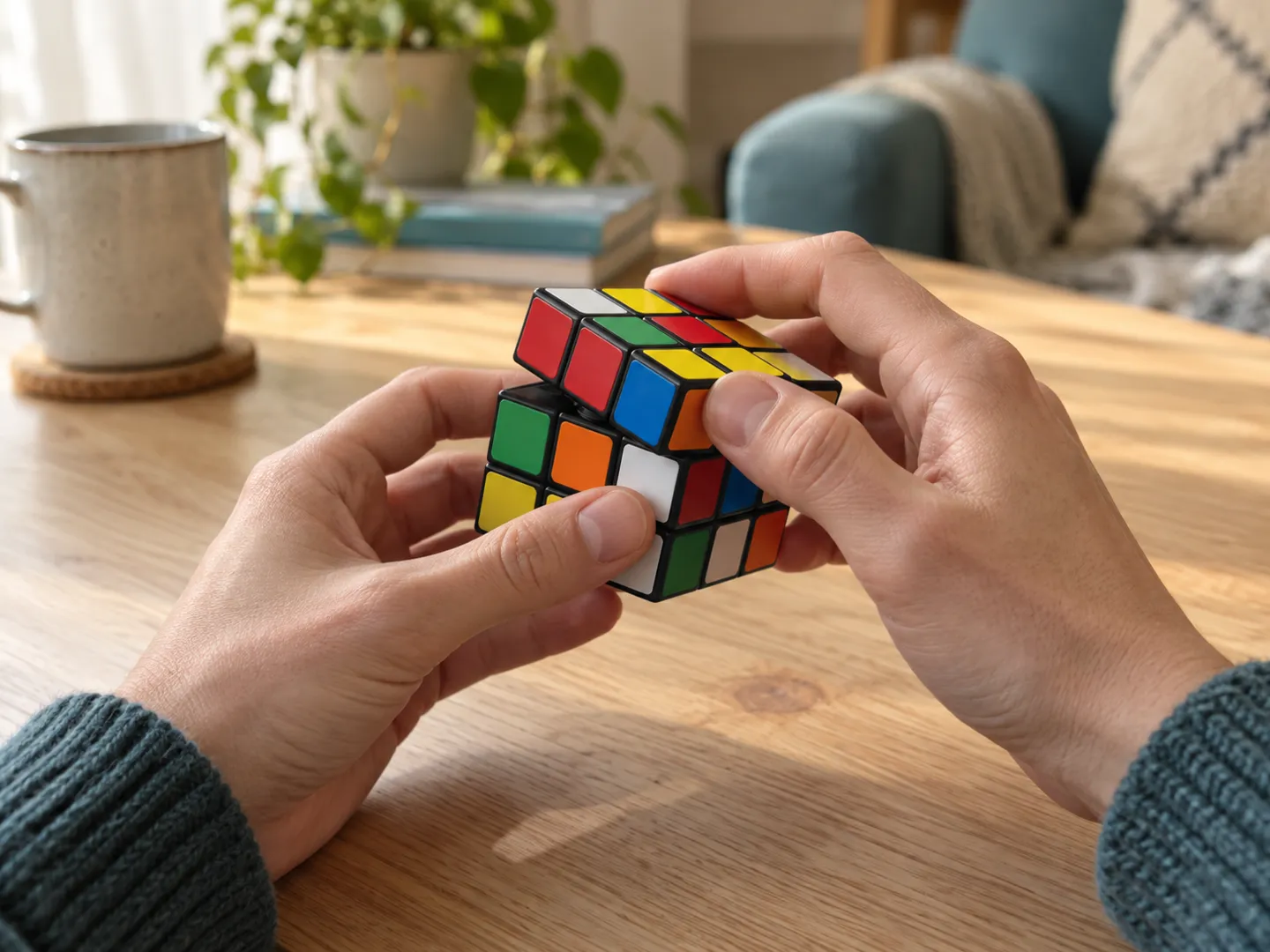
Turning the faces of a 3×3×3 puzzle cube can produce 43,252,003,274,489,856,000 different positions, about 4.3 × 10¹⁹.
In July 2010 a team proved that God’s number, the most moves the hardest position needs, is 20. As recently as March 2008, the best proven limit was 25.
The first position shown to need 20 moves is the superflip: every piece in its home spot, with all the edges flipped. Michael Reid showed this in 1995.
07QUICK QUESTIONS
Short answers to the questions people ask most.
Cubing a number means multiplying it by itself three times. Three cubed, written 3³, is 3 × 3 × 3 = 27. The name comes from geometry: 27 small blocks fit together into a cube three blocks long, wide and tall.
There are 43,252,003,274,489,856,000 positions that can be reached by turning the faces, about 43 quintillion. That figure counts only positions you can reach by turning, not ones made by taking the cube apart.
God’s number is the largest number of moves needed to solve the puzzle cube from its hardest position, if you always use the shortest solution. In July 2010 a team proved it is 20, counting any turn of a face as one move.
1729 is the smallest number that can be written as the sum of two positive cubes in two different ways: 1³ + 12³ and 9³ + 10³. It is known as the Hardy-Ramanujan number.
Yes. The first n cubes always add up to the square of 1 + 2 + … + n. For example, 1³ + 2³ + … + 10³ = 3,025, which is 55², and 55 is 1 + 2 + … + 10.
08Sources
A NAME WITH DEPTH
doodlecubed.com is part of the DoodleSale portfolio. It isn't in an auction right now, but you can ask about leasing it.